On October 20, we introduced MirrorShip Intelligence Platform (MIP), extending our real-time analytics foundation into a unified platform for data analytics and AI.
At the launch, MirrorShip CTO Peng Chen walked through the architecture: how MIP brings data access, business definitions, and data agents together—and how those capabilities build on the technology our customers already use.
StarRocks remains central to our real-time analytics stack. MIP builds on that foundation, adding an enterprise semantic layer and agent-based analytics under a shared governance framework. Existing reporting and analytics applications can continue to run as organizations introduce new AI workloads within the same platform architecture.
Three Layers, with Governance Across the Stack
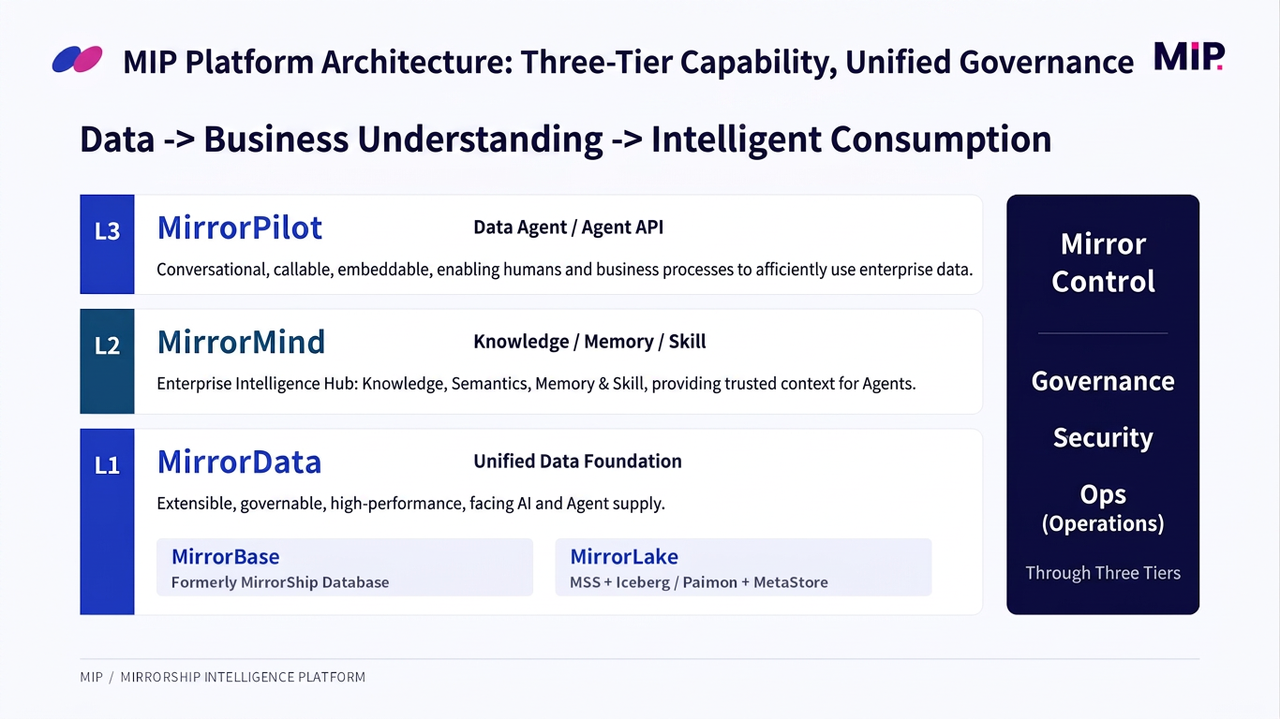
MIP separates the work of accessing data, defining its business meaning, and delivering analysis into three layers:
- MirrorData provides the data foundation, combining real-time analytics with access to open lakehouse storage.
- MirrorMind defines the metrics, relationships, and business context that guide analysis.
- MirrorPilot makes those capabilities available through conversational analytics and integrations with business applications.
MirrorControl spans all three, providing access controls, resource management, tracing, and operational support.
The layers have distinct responsibilities, but they are designed to work together. An agent needs more than a fast query engine: it also needs to know which metric to calculate, which data it may access, and how to explain the result. MIP connects those requirements within one architecture.
MirrorData: A Common Foundation for Analytics Workloads
Consolidating the Query Layer
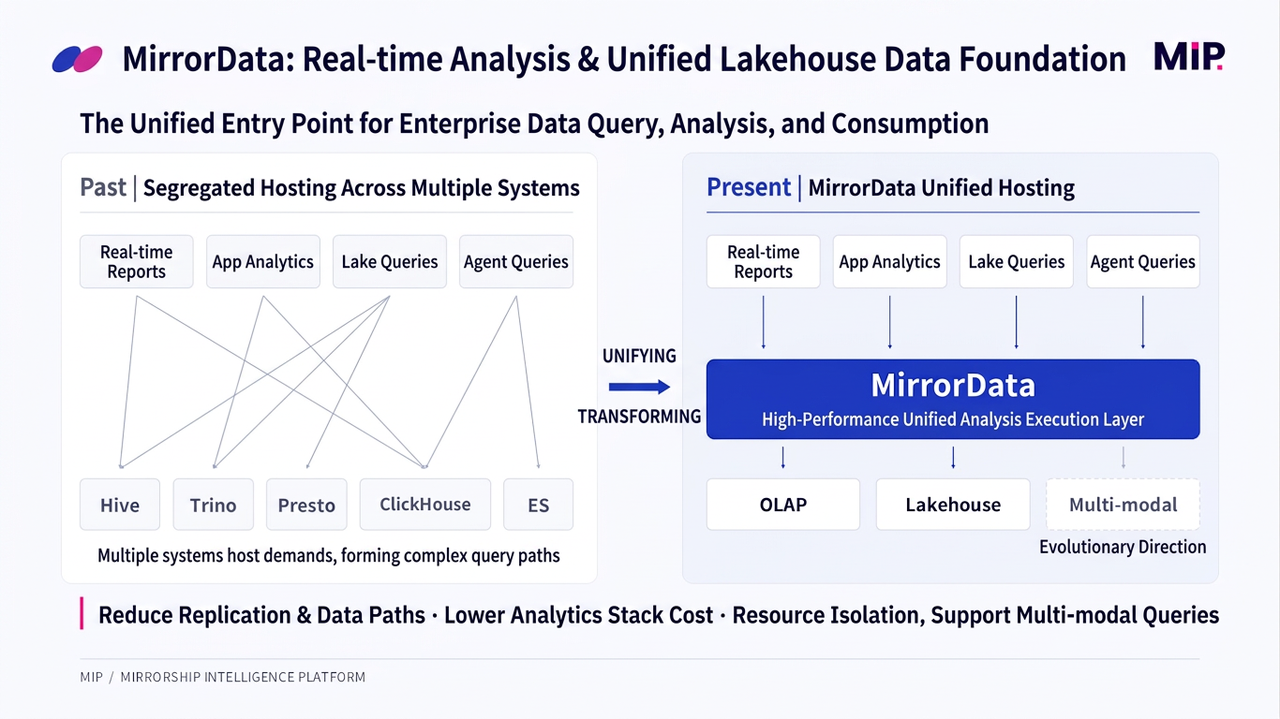
Enterprise analytics rarely runs on a single system. Real-time dashboards, application queries, and lake analytics may rely on different engines, while agents introduce another source of frequent data access.
Over time, that can leave teams maintaining a mix of Hive, Trino, Presto, ClickHouse, Elasticsearch, and other systems, each serving part of the workload.
MirrorData provides a shared execution layer for these query and analytics needs. Consolidating execution helps reduce repeated data copies and transfers, as well as the complexity of operating separate query paths.
It also provides resource isolation to help agent workloads run alongside existing business queries without competing unchecked for the same resources.
MirrorBase and MirrorLake
Two components underpin MirrorData.
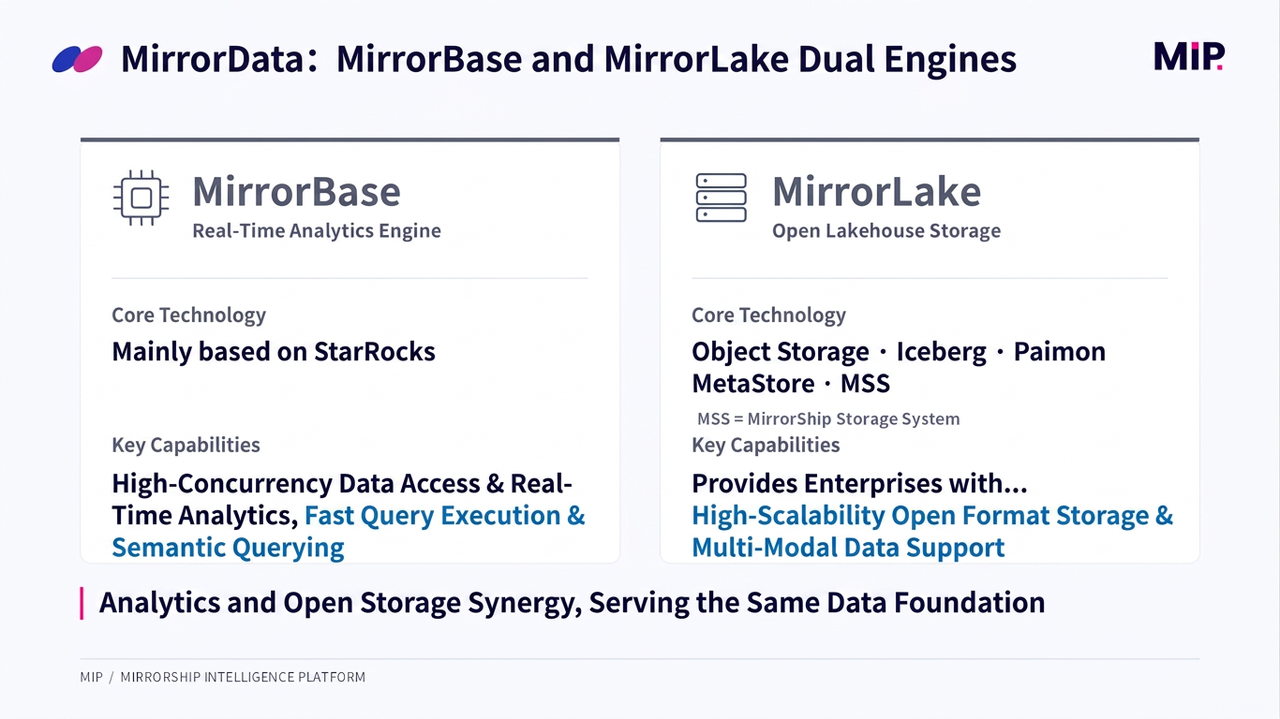
MirrorBase is the real-time analytics engine, built primarily on StarRocks. It provides the low latency and high concurrency needed for interactive analytics and data applications.
MirrorLake provides open lakehouse storage. It brings together object storage, Iceberg, Paimon, MetaStore, and MSS (MirrorShip Storage System) to support scalable storage in open formats and accommodate multimodal data.
Together, they connect analytics execution with open storage, giving applications a common foundation for working with different types of data.
Extending Analysis Beyond Tables
Business questions do not always fit neatly into rows and columns. Relevant information may be spread across transaction tables, documents, images, audio recordings, and video.
Power infrastructure inspections are one example. An investigation may require asset records, inspection photos, drone footage, and audio notes to be analyzed together. Traditionally, separate tools extract frames, identify content, and add labels before the results are moved into an analytics system. That adds processing steps and can create redundant copies of the data.
MirrorLake’s roadmap brings structured, semi-structured, and vectorized data into the same analytics foundation. MirrorShip is focusing on the storage, querying, analysis, and use of multimodal data, starting with high-value use cases that require different data types to be analyzed together. Ecosystem partners support the broader workflow, from data processing to application delivery.
The aim is not to replace every system involved in that workflow. It is to give reports, applications, and agents a consistent way to access and analyze the data they need.
MirrorMind: Make Business Definitions Explicit
Access to data does not tell an agent how the business defines a metric.
In a traditional analytics workflow, much of that knowledge is built into data models and reports. Modelers and developers decide which fields to use, how tables relate, and which calculation rules apply.
A natural-language interface changes the interaction, but it does not remove those decisions. When someone asks a question, the system still needs to determine the intended metric, the relevant data, the reporting period, and the user’s access permissions.
MirrorMind provides an enterprise semantic layer that makes those definitions available to users, applications, and agents. Instead of leaving each agent to infer business meaning independently, it gives them a shared set of definitions to follow.
Calculation Rules and Explanatory Context
MirrorMind has two complementary components.
Semantic View captures business definitions that can guide computation: metrics, dimensions, table relationships, and related rules. These definitions provide a reusable basis for query generation and access control.
Knowledge Context captures the explanation around those definitions: what a term means, why a metric is calculated a particular way, and where the definition came from. It provides storage, retrieval, and governance for that knowledge, and can connect to existing enterprise knowledge bases, including business documents in Feishu.
Take “sales” as an example. The calculation needs a defined scope and time period, but users may also need to understand why those rules apply. Semantic View specifies the calculation; Knowledge Context supplies the rationale.
Together, they support both producing an answer and explaining what that answer means.
MirrorPilot: Put the Semantic Layer to Work
MirrorPilot is the agent layer that brings MIP’s analytics capabilities to users and business systems.
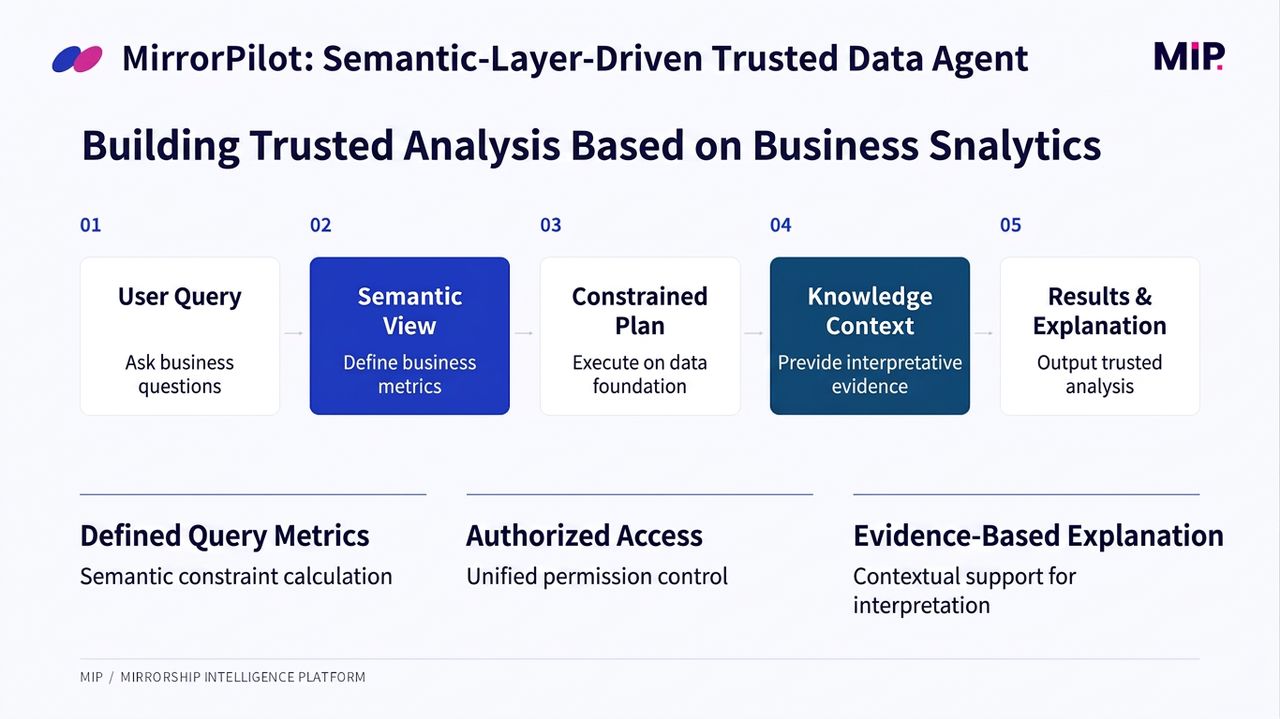
When a user asks a question, MirrorPilot uses Semantic Views to identify the relevant metrics, data entities, and constraints. It develops a query plan, passes execution to the data foundation, and draws on Knowledge Context to explain the results.
That workflow connects three tasks that need to stay aligned: interpreting the business question, running the calculation, and explaining the outcome.
MirrorPilot’s approach to trustworthy analysis rests on three practical requirements:
- Calculations follow shared definitions. Semantic rules guide how metrics are computed.
- Data access respects permissions. Analysis stays within the user’s authorized scope.
- Explanations have a business basis. Relevant definitions and context help users interpret the result.
The goal is to make analysis useful in day-to-day work while making it easier to understand how a result was reached.
A Conversational Interface—or Analytics in Your Existing Workflow
MirrorPilot supports two ways to use the same underlying capabilities.
The first is a standalone conversational analytics interface, also known as ChatBI. Business users can ask questions, explore data, and discuss results in natural language.
The second brings analytics into existing applications, workflows, and business agents through APIs, MCP, or Skills. Users can get analytical support in the context of the task they are already working on.
Both approaches use the same data foundation, business definitions, and governance controls. The entry point may change, but the rules for calculating a metric or accessing data should not.
MirrorControl: Govern Access, Resources, and Operations
Enterprise analytics needs controls that extend beyond the final answer. Teams need to know who can access the data, how workloads share resources, and whether an agent’s analysis can be inspected afterward.
MirrorControl provides those capabilities across the platform:
- Access and resource controls manage data and agent permissions, with multi-tenant resource isolation to limit interference between workloads.
- Auditing and observability trace agent queries, exploration, and analysis so teams can inspect the process.
- Deployment compatibility continues to expand through adaptation and certification for China’s domestic IT platforms and processors.
- AI-assisted operations build on the DevOps Agent already available for MirrorBase, with related capabilities planned for MirrorLake.
These controls support both existing analytics applications and the agent workloads being introduced alongside them.
What Happens When a User Asks a Question?
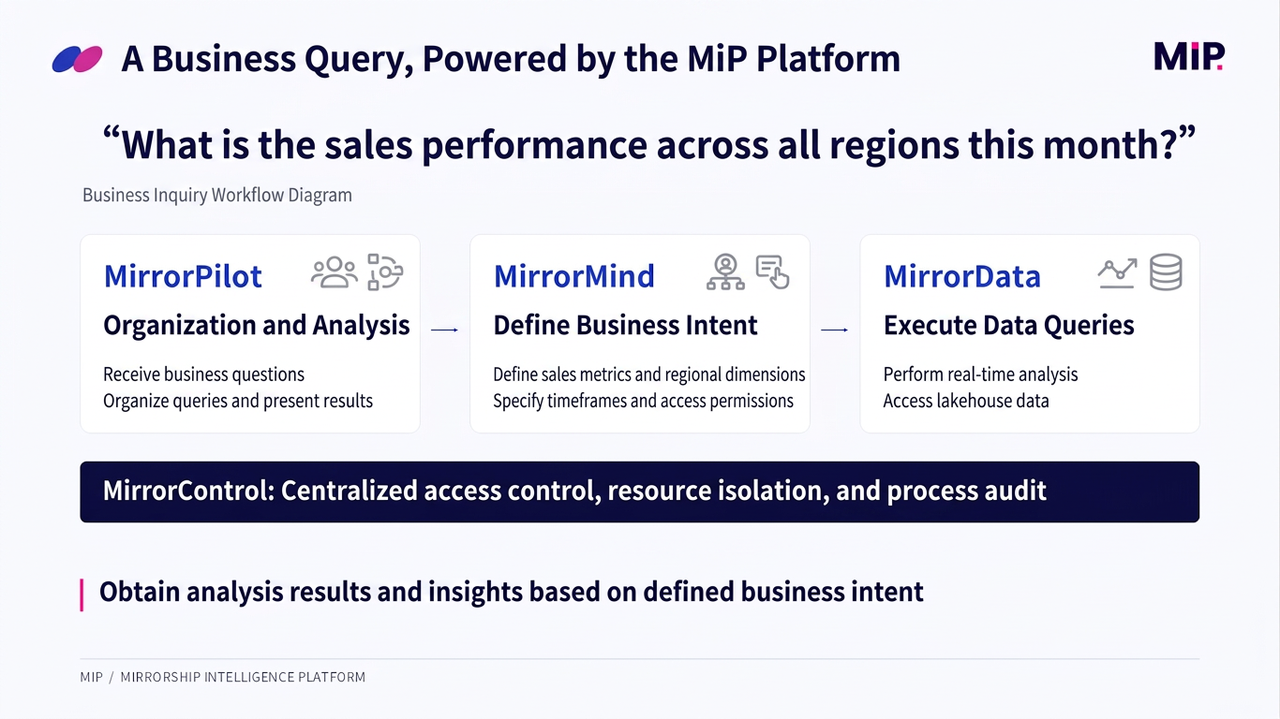
Consider a straightforward request:
“How are sales performing across regions this month?”
Answering it involves every layer of the platform.
MirrorPilot takes the question and coordinates the analysis. MirrorMind supplies the sales definition, regional dimensions, reporting period, and applicable access permissions. MirrorData executes the queries against the relevant data. MirrorControl applies access controls, manages resource isolation, and maintains the audit trail.
What comes back is more than a query result. It is an answer calculated using the organization’s business definitions, limited to the data the user is allowed to access, and accompanied by the context needed to interpret it.
That is the architectural step MIP takes beyond real-time analytics: connecting fast access to data with explicit business meaning and agent-based delivery.
From Data to Understanding.
Watch the MIP launch replay at mirrorship.ai for a closer look at the architecture and how the platform’s components work together.